
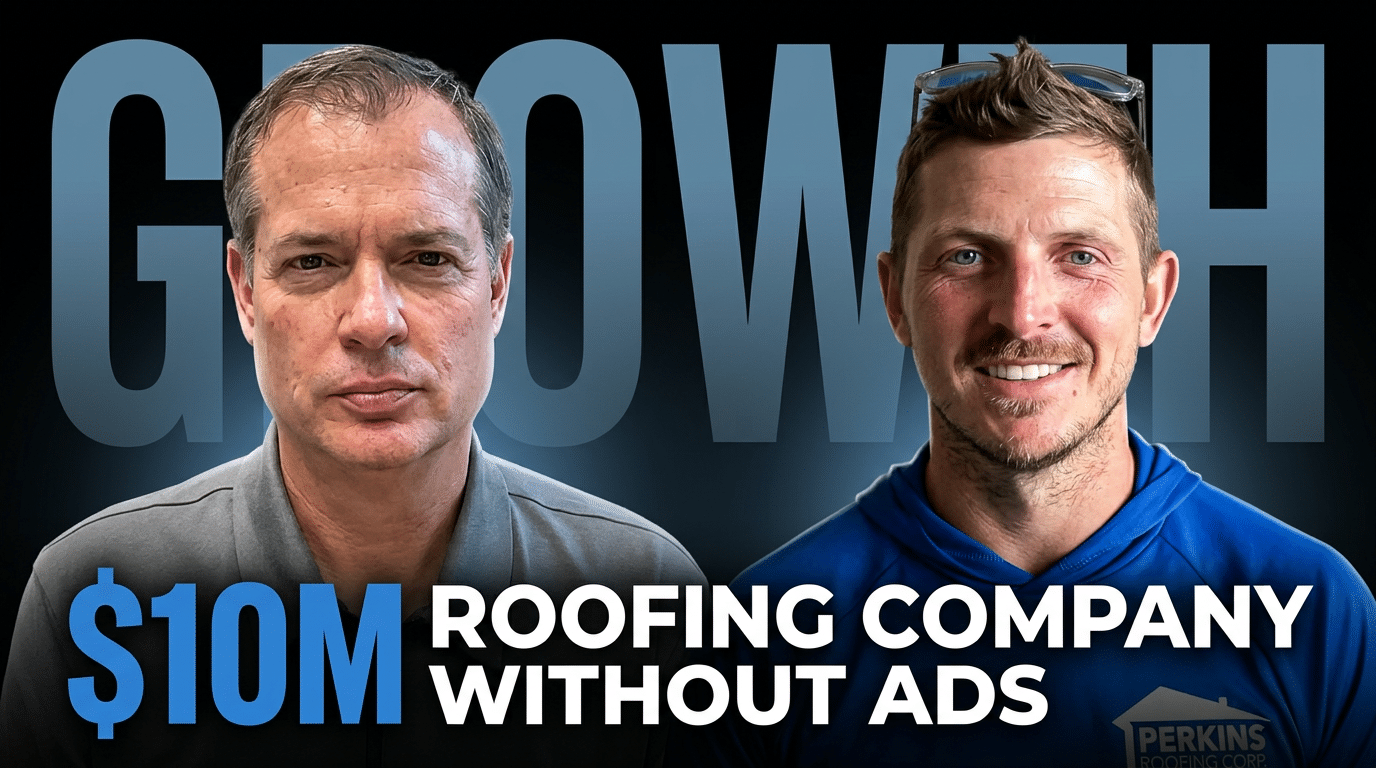
Tim Kanak didn’t set out to become a roofer. He had a master’s degree in education and plans to coach high school football in Miami when he spent a summer working for his father-in-law’s roofing company at $15 an hour. That was well over a decade ago. Today, Perkins Roofing generates close to $10 million a year from its Miami branch alone, and Tim owns the company outright.
On a recent episode of Everyday Excellence, hosted by Todd Baldwin of Everyday Media Group, Tim shared how he modernized a business that was about to close, grew it from $500,000 to $10 million in revenue, and built a marketing engine that runs almost entirely on YouTube content instead of paid advertising. The conversation covers real decisions, including some that cost him tens of thousands in wasted ad spend, with the kind of specific detail that makes it genuinely useful.
From Football Coach to $10 Million Roofer
When Tim arrived at Perkins Roofing, the company was in wind-down mode. His father-in-law, Dean, had founded it in 1980, but his sons weren’t interested in taking it over. The whole operation ran on legal pads and manila folders. Estimates were stored in filing cabinets. Nothing was digital.
Tim spent his days doing repairs alongside a small crew and his evenings learning how the business ran. He moved everything to Google Drive, switched accounting to QuickBooks Online, and digitized years of paper records. He did it without getting paid for the extra time, and the effort didn’t go unnoticed. Within six months, he was the operations manager. Not long after, he encouraged Dean to step back and let him run things.
Revenue grew from $500,000 to $5 million in the first few years, and the Miami branch now does close to $10 million annually. Tim eventually bought the company with a 0% interest note, with 50% sweat equity baked into the deal. ‘He earned it,’ Tim said of his father-in-law. ‘It’s his retirement.’ No regrets, even knowing he’ll be writing monthly checks for another 20 years.
How a New Branch Broke Even in Three Months
When Tim opened the Jupiter branch in Palm Beach County, he had no clients, no local relationships, and was operating under a different building code than Miami. Florida and Louisiana are the only two states with dual building codes. Miami’s high velocity hurricane zone standard requires more fasteners and restricts certain roofing products. Palm Beach County doesn’t carry those same requirements, which meant Tim had to learn new code and adapt how he presented his work to customers.
He broke even within three months, and his YouTube channel was the primary reason. Before setting up operations in Palm Beach, he posted a video announcing the expansion. It found an audience immediately: Miami residents moving northward who still wanted the higher-end construction standard Tim was known for.
‘There were a lot of people from Palm Beach County who wanted a roofer who knew how to do high velocity hurricane zone,’ Tim said. He already had their trust from years of content. The calls came in before he had time to settle.
The YouTube Strategy Behind 80 to 90 Percent Close Rates
Tim’s YouTube channel, Perkins Roofing, may be the most productive marketing asset in Florida’s residential roofing space. By his estimate, he has produced more hours of roofing content than some roofing manufacturers with corporate teams behind them. His background in broadcast journalism and education shapes the approach: he teaches, he doesn’t sell.
Most homeowners put 30 minutes into researching a $50,000 roof while spending hours comparing $30,000 cars. Tim’s videos fill that gap. He covers hurricane zone codes, fastener requirements, what to look for in a contractor’s bid, and why certain roofing products don’t hold up in Florida’s climate. Engineers make up a significant share of his client base because they do the research and recognize when someone actually knows what they’re talking about.
The business payoff is measurable. His YouTube leads close at 80 to 90 percent, compared to the typical one-in-three or one-in-five rate from cold phone leads. ‘I go to job sites where they tell me, I’m just telling you from the bat, I’m hiring you,’ Tim said. ‘I trust you. I know you’re not gonna screw me over. I’m not even going to get other bids.’
Todd Baldwin, who leads Everyday Media Group and has worked in digital marketing for over 20 years, highlighted why this approach matters even more now. ‘It’s all about authoritative content, FAQs, answering these questions,’ Todd said. ‘Google and the LLMs are looking for who answers these questions.’ Educational video content, properly optimized and repurposed for the web, feeds directly into AI-powered search results.
When $10,500 in Facebook Ads Returned One Repair Lead
Tim has tested paid advertising, and he was candid about how those experiments went.
The Facebook campaign lasted about three months at $3,500 per month. Total spend: around $10,500. Total return: one repair lead worth $2,000. The agency’s response when Tim questioned the results? ‘Sometimes you win, sometimes you lose. It’s a long game.’
The YouTube remarketing experiment followed a similar pattern. Tim’s instinct was sound: retarget viewers who had already watched more than two minutes of his videos. The agency agreed it was a great idea and asked for $2,000 per month. After five months, Tim requested geographic data on who was being retargeted. Only 6 percent of the retargeted audience was in Florida. The rest were spread across Texas, California, and South Africa.
‘Aren’t you the marketing expert?’ Tim asked. ‘Why didn’t you do this from the beginning? We’re only in these locations.’ He fired the agency.
Todd Baldwin’s reaction was blunt: ‘That’s the bad agency mentality.’ A well-run paid campaign on Google’s local service ads platform starts with intent. Someone searching for a roofer already has a problem. Facebook requires a different strategy and testing process. Tim had the video assets and the customer profile data to make paid work. He just hadn’t found the right partner.
Grassroots Marketing That Costs Almost Nothing
Tim’s paid marketing spend is minimal. He pays a few thousand dollars monthly for website maintenance and an ongoing project to convert his YouTube video transcripts into web-optimized content for AI-driven search. Everything else is grassroots.
His referral program is simple: $250 for a repair referral that turns into a job, $500 for a re-roof referral. He tells everyone and generates consistent leads from it. He also joined the Chamber of Commerce and a BNI-style networking group called MPI, and when he first expanded to Palm Beach County, he threw a brewery event and cold-called general contractors and property managers with an offer of free food and drinks. The event cost around $1,000.
About 30 to 40 people showed up. Tim didn’t know anyone in Palm Beach County at the time. One of those attendees was an HOA board member from a gated community. That single connection has since led to more than 20 roofing projects in that neighborhood.
Knowing Your Numbers Better Than Any Competitor
Tim’s average roof in Florida costs around $50,000. Profit margins run 10 to 20 percent during rainy season (June through November) and tighten during dry season (December through April) when demand drops and Tim focuses on keeping his crews busy.
What sets him apart from most roofing contractors isn’t the margins. It’s that he knows the cost of every job before the bid goes out. ‘There’s no guesswork,’ he said. ‘I know to the dollar amount how much each job is going to cost me going in.’ Many roofing companies simply guess at square pricing based on what competitors charge. Tim knows his floor and ceiling on every project before he steps foot on site.
The work of building the Perkins Roofing FDD (Franchise Disclosure Document) required him to document everything, which is where his detailed client profile came from: an average home value of $777,000, household income above $150,000, homeowner age between 45 and 65, primary residence. These are people buying on quality, not lowest bid. Tim targets those neighborhoods specifically and doesn’t dilute his pipeline chasing work that doesn’t fit the profile.
Building Company Culture Around Accountability and Transparency
Perkins Roofing’s internal culture was built on two pillars: Extreme Ownership by Jocko Willink and the EOS framework. Tim ran a chapter-by-chapter read-through of the book with his entire team, meeting weekly to discuss each section. ‘We literally did a book club for the business,’ he said. Accountability became a defining value.
He uses EOS for structured meetings, quarterly rocks (priority goals), and issue-tracking. On the client-facing side, communication is non-negotiable. Every project has a group chat where any team member can respond to client questions at any time. The company uses CompanyCam to document each job stage with photos.
Tim also refuses to run the wood change-order play common in the industry, where a contractor bids low and pads costs by inflating the amount of plywood changed during installation. ‘I tell them from the beginning: here’s your costs,’ he said. ‘You’re gonna have happy clients at the end.’ His pricing structure starts at the ‘Protector’ tier, which he describes as equivalent to most competitors’ premium offering. That’s where Perkins starts. Quality work reduces callbacks, and reduced callbacks protect both margins and reputation.
The Franchise Model Tim Calls a ‘Cheat Code’
Perkins Roofing is one of very few roofing companies in the country with a completed FDD. Tim spent roughly a year writing the operations manual himself and building a video-based training program that functions like an online college course for roofing. The Naples branch, launching soon, is the first franchised location.
The numbers he cited make the case plainly. Ninety-six percent of roofing companies go out of business within their first five years. Eighty percent don’t make it past year three. Tim’s own path involved lawsuits, employee theft, insurance fraud attempts, and projects that lost tens of thousands of dollars before he built the systems to guard against them.
‘Take the shortcut,’ was his advice to someone starting out in contracting. ‘The hard way is the way I did it, where I had to learn all the lessons myself. I didn’t have anyone to teach me these things.’ Franchisees don’t need prior roofing experience, but Tim recommends partnering with someone who has a construction background. Florida law requires the license holder to own at least 10 percent of the business.
What comes with the franchise is a weekly mastermind program connecting every branch, corporate and franchised alike. Issues, rocks, and long-term goals are worked through together. ‘You’re basically getting a mentorship,’ Tim said. His five-year goal is one new location per year, starting in Florida and moving through the Southeast.
What Contractors Can Take From Tim’s Marketing Playbook
Tim Kanak’s marketing success isn’t really a marketing story. It’s a story about knowing a trade well, documenting that knowledge consistently, and putting it where people with questions can find it.
His YouTube channel works because he teaches roofing the way he was trained to teach: using his background in education and broadcast journalism to present technical information in a format homeowners can actually use. The grassroots networking works because it’s targeted and followed through. The referral program works because it’s clear and consistent. The SEO investment makes sense because the content already exists.
For contractors working with Everyday Media Group, the conversation with Tim reinforces what Todd Baldwin sees across the agency’s client base: the business owners who get results understand their numbers, show up for strategy conversations, and treat marketing as a system rather than an on-off spend.
‘If you’re working with the right agency,’ Todd said, ‘you can really have a good strategy to help toggle up and down based on what’s going on with seasonality and your business.’ That insight, which Tim’s own paid ad history underlines, is what separates a good agency relationship from a $10,500 Facebook experiment that returns one repair lead. To connect with Tim Kanak about Perkins Roofing franchise opportunities, email [email protected]. For roofing or GC services across South Florida, call 305-MIA-ROOF.