
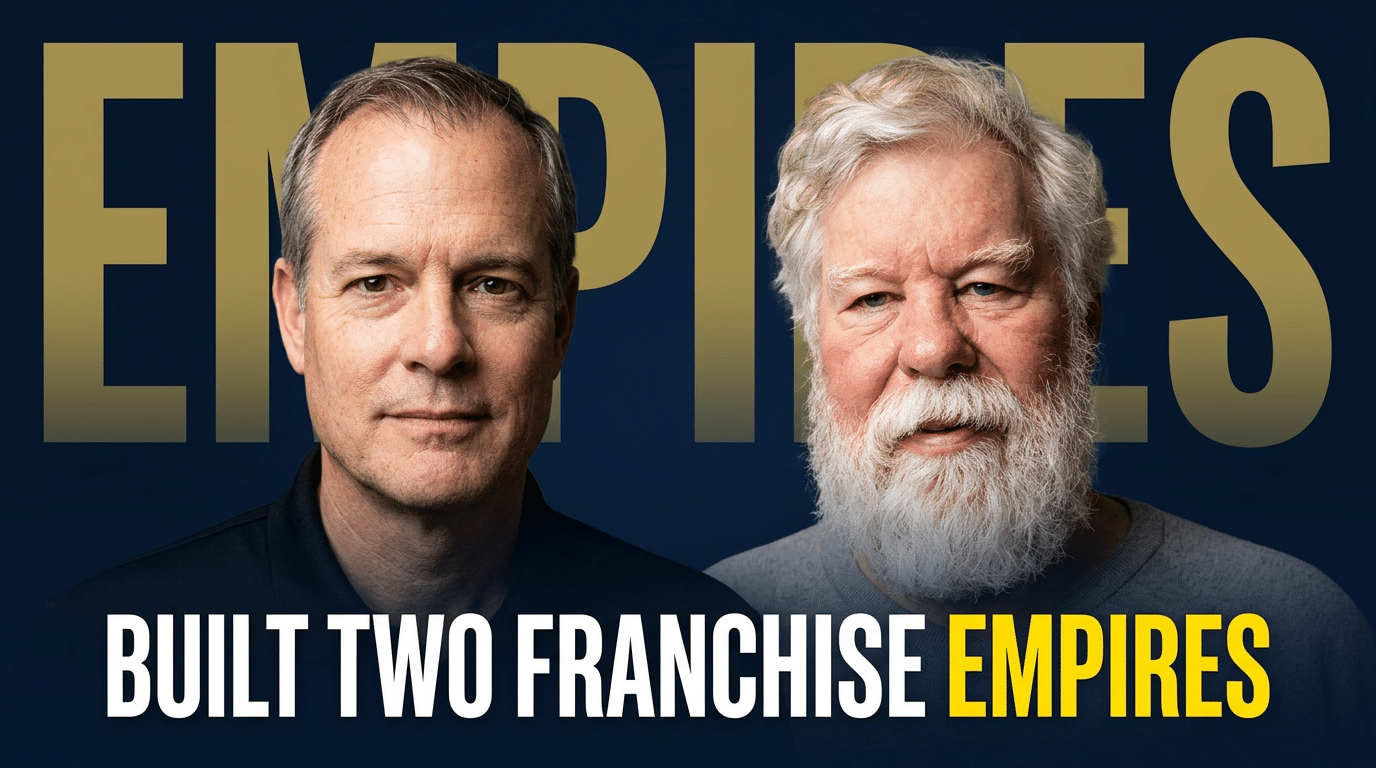
John T. Hewitt has completed 57 consecutive tax seasons. He built one of the largest franchise systems in U.S. history, sold it, built a second one in Canada from scratch, brought it back to the United States to compete against his own name and software, and has now launched a third platform in a completely different industry. He has created 1,100 millionaires, helped nearly 6,000 franchisees build businesses, and shows no signs of stopping.
The origin of all of it was a tax course he took at the University of Buffalo in 1969 when he was 20 years old. He took it to get a job at H&R Block. What he found was a calling. As he told Todd Baldwin on a recent episode of Everyday Excellence: most people at any age don’t know what they want to be when they grow up. He knew at 20.
In this conversation, John shares how he went from managing 250 H&R Block offices to buying a six-location tax company and aiming for 9,001 locations. He breaks down what the franchise model actually is, what the number one mistake new franchise owners make, and what he sees growing at 13 to 15 percent a year in today’s market. The lessons travel well beyond tax.
The Technology Blindspot That Built a Billion-Dollar Advantage
In 1993, H&R Block was a Fortune 500 company with 9,000 locations. They wrote something in their annual report that year that John still references: people ask us why we don’t computerize. And their answer, written publicly for investors to read: ‘We tried it. It doesn’t save us any money. Customers don’t care. We’re never going to computerize.’
By that point, Jackson Hewitt had been computerized for eleven years. John had opened the company in 1982 specifically because of computers. His father had bought one of the first Apple computers and convinced him that tax preparation could be digitized. John left a thriving career at H&R Block managing 250 offices because of that single idea.
When the IRS rolled out electronic filing, they came to Jackson Hewitt for cooperation and support because no one else was ready. John’s team wrote the e-filing software for New York and Oregon. H&R Block had handed them a two-year technology head start and then documented, in their own annual report, the decision to stay behind.
That advantage carried Jackson Hewitt to 6,000 locations and into billion-dollar territory. John sold it in 1997, fifteen years after walking into a widow’s office in Virginia Beach to buy six locations.
From Six Offices to 6,000: The Pivot That Changed the Scale
When John bought Mel Jackson’s six tax offices in August 1982, he had a number in mind. H&R Block had 9,000 locations. Jackson Hewitt would have 9,001. The math of his early growth told a different story: eleven locations by January, fifteen the following year, twenty-two the year after that. At that rate, he said, he would be 1,000 years old before reaching the goal.
The solution had been in front of him the entire time. H&R Block had been 95 percent franchise when John joined them in 1969. Twelve years inside that system and he had still not made the connection for his own company. The moment he made the franchise pivot, the trajectory changed. Within two years, Jackson Hewitt went from 22 locations to more than 200. The model that had built the industry he came from was the same model that would scale what he was building.
The same story played out again with Liberty Tax. After the Jackson Hewitt non-compete pushed him to Canada, Liberty Tax became the number two tax company in the country within three years. Just H&R Block and Liberty Tax. When John returned to the U.S., he grew Liberty Tax to 4,000 locations, making it one of the top 10 fastest-growing franchisors in history. He says he grew faster than H&R Block and Jackson Hewitt combined.
The Franchise Philosophy: People Who Pay You to Work for You
John is direct about why the franchise model works the way it does. His framing cuts through all the softer language most franchise presentations use.
“I get very smart, talented people to act like owners, to pay me to work for me.” He makes the comparison plain: with an employee, he has to pay them and they act like employees. In all the thousands of employees across his career, fewer than 5 percent act like owners. Most franchisees act like owners. The difference is skin in the game. When someone puts their own capital and livelihood into a business, they show up differently.
The flip side of that ownership mindset is accountability. John does not sugarcoat it. As an entrepreneur, no one is telling you to be at your desk at 8 a.m. The entire weight of the operation sits on your own decision-making. His phrase for the right orientation: “If it is to be, it is up to me.” That two-letter word combination, he says, is the most important in the English language for a business owner.
Loyalty Brands and the Bet on the Pet Industry
After the Liberty Tax non-compete, John gathered his core team again and asked the same question he has always asked at a reset: which industries are growing fastest in franchising right now? They landed on pets and construction, with pets as the clear standout.
The mobile pet grooming segment in particular is tracking 13 to 15 percent annual growth. Tax, by comparison, grows about 1 percent per year. Tax is reliable and recession-resistant. People file regardless of economic conditions. But pets generate a different kind of emotional connection and a different growth curve.
John draws the parallel to how delivery transformed the food industry. Fifty years ago, Domino’s was the only pizza company that delivered. Today delivery is a baseline requirement for any restaurant. Twenty years ago, Grubhub and Uber Eats did not exist. Now on-demand delivery is how food service works. Mobile grooming is following the same arc. Bringing the service to the customer’s door removes friction, improves the experience, and builds the kind of recurring client relationship that compounds over time.
What Separates Winners: Perseverance, Systems, and the Four Questions
When Todd asked what separates entrepreneurs who win long-term from those who burn out, John gave a clear answer. The number one trait is perseverance. Not talent. Not capital. Not timing. Perseverance. “God doesn’t place anyone here to skate through. We all face adversity.” His phrase for the standard every serious entrepreneur has to hold: “They gotta kill me to stop me.”
The second most important trait is the willingness to follow a proven system, and John makes the logic almost mathematically simple. Listen 98 or 99 percent of the time, and you are a superstar. Listen less than 90 percent, and you will fail. He does not soften this. “Why would you pay me to not listen to me? You can not listen to me for free.” He references Adam and Eve as the first people who did not listen to good advice, which makes the point.
He also notes a pattern that holds across thousands of franchisees: first-generation immigrants outperform on average. They are hungrier. They are more driven. The American Dream is not a phrase to them. It is a goal they came to this country specifically to reach. That drive is what shows up before anyone tells them to.
For anyone evaluating whether to start a business, John offers a four-question framework: Are you meant to be self-employed? Is this the right industry? Is this the right company? Is this the right time in your life? All four have to point in the right direction before the investment makes sense.
Underneath all of it is a mission statement he shares openly, to the point of telling people to steal it: “Having fun, improving lives.” His number one achievement in 57 years is not the scale or the exits. It is the 1,100 millionaires he has helped create and the tens of thousands of people whose lives are measurably better because of what his companies gave them the opportunity to build.
At Everyday Media Group, Todd Baldwin and the team work with franchise systems and home service businesses to build the digital foundation that supports growth at the local level. John’s lesson about following proven systems applies as directly to SEO and content strategy as it does to franchise operations. Businesses that commit to a proven approach and stay consistent outperform the ones that improvise.
Key Takeaways
- “They gotta kill me to stop me.” Perseverance is not one of several important traits. It is the primary one. Every business that survives long enough to succeed goes through adversity that would justify quitting. The ones that make it are the ones where the founder refuses to stop, no matter what comes at them.
- “You listen 98 or 99% and you’re a superstar. If you listen less than 90%, you’re going to fail.” Following a proven system is not a passive act. It requires actively overriding the instinct to substitute personal judgment for tested process. The businesses that win are not the ones with the most creative founders. They are the ones where the founders trust the system they paid to join.
- “Having fun, improving lives.” A mission statement worth measuring everything against. If you cannot say yes to both halves on a Monday morning, something needs to change. John has used this standard across five decades and three franchise platforms, and it still answers every decision.
About John T. Hewitt
John T. Hewitt is the founder of Jackson Hewitt and Liberty Tax Service and the CEO of Loyalty Brands. Over a 57-year career in tax preparation and franchising, he has built systems with more than 11,000 offices and nearly 6,000 franchisees, created 1,100 millionaires, and been recognized as Entrepreneur of the Year by Ernst and Young in 2003 and by the International Franchise Association in 2005. He is currently expanding Loyalty Brands across the pet, construction, and tax sectors.
Learn more and explore franchise opportunities at loyaltybrands.com.
Running a Business and Not Sure Your Digital Marketing Is Actually Working?
Everyday Media Group works with franchise systems and home service businesses across the United States to build the kind of SEO and content foundation that drives consistent leads over time. If your current digital marketing feels like a black box, schedule a conversation with Todd Baldwin and the team. The goal is a long-term partnership that earns its place, not just a sales call.