
At two in the morning, Brent Garrett was staring at the ceiling trying to figure out how he was going to explain what was happening to his wife, his kids, and his vendors. The speaking business was thriving. The plumbing business was nearly a million dollars in debt. He had a four-year-old and a six-year-old and he was on the road 120 days a year.
He made a choice. He shut down the speaking business, stopped being a suitcase dad, and fixed the plumbing company. Looking back on it now: “I thought I was putting my bags on the floor because I had to save my business. But what it really did was it saved my life.”
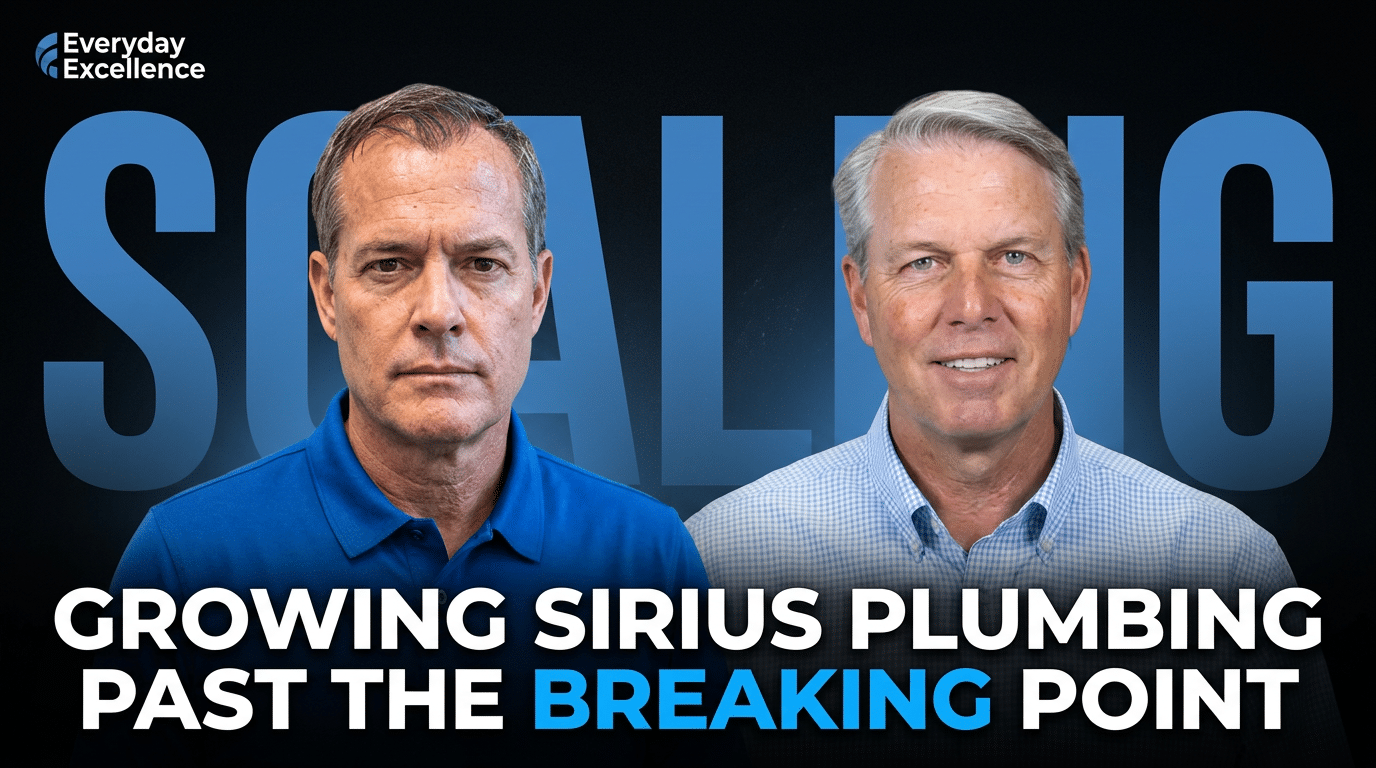
On a recent episode of Everyday Excellence, Todd Baldwin sat down with Brent Garrett, owner of Sirius Plumbing and Air Conditioning in North Dallas and a small business coach for skilled trades owners, for a conversation that covers the messy middle every contractor eventually hits, why culture eats strategy for breakfast, what needs-based selling actually looks like in a service call, and how hope is not a plan when it comes to marketing.
Seventeen Trucks, Five Million Dollars, and the Path That Built Both
Brent started in plumbing at age 12 on the end of a shovel working for his father, a Korean War veteran who ran a three-truck operation and put four kids through school. Brent earned an accounting and marketing degree, briefly broke his father’s heart by leaving the trade, and came back to it: opening his first plumbing company in Richardson, Texas in 1994 with $5,000, a 50-page business plan, and an Astro Van.
Five years later, that company had 15 employees and was sold to American Residential Services, a Fortune 300 company that owned True Green ChemLawn, Merry Maids, and a portfolio of residential service brands. That first exit was Brent’s proof of concept. The second business was where the real education happened.
Today Sirius Plumbing and Air Conditioning runs approximately 17 trucks, does just over $5 million in revenue, and is targeting $10 million. Brent also operates a small business coaching practice at BrentGarrett.com for skilled trades owners across the country, and is releasing the first of a four-book series titled 30 Days to a Better Business, designed specifically for plumbing, HVAC, and electrical contractors.
The Messy Middle and Why Most Contractors Get Stuck There
Brent has a name for the point where most skilled trades businesses stall. He calls it the messy middle, and it follows a predictable pattern. A contractor is excellent at their trade. They do good work, communicate well, and grow the business through word of mouth. At two or three trucks, things are good. Then they hit four or five trucks and something changes.
The work multiplies faster than the systems do. The owner is suddenly responsible for accounting, payroll, HR, pricing, and marketing, none of which they signed up for. Their answer to all of it is to work longer hours. And here is the counterintuitive part: companies in the messy middle are often less profitable at five trucks than they were at two. Parkinson’s Law: inefficiency expands to fill the space available. Expenses go up, margins compress, and the last thing getting done is sales. When sales drop, cash gets tight, and the business is suddenly at risk from the same growth it was chasing.
The five stages Brent maps for business ownership: solopreneur, small team, the messy middle, coaching the coaches, and finally owning a legacy rather than a job. The path from the messy middle to coaching the coaches requires the owner to step out of the field and into leadership, whether they feel ready or not.
His own version of this was giving away all his tools. He had a pattern of hopping in the truck to fix problems the moment something went sideways in the office. The only way he broke the habit was making himself unable to do it. Burn the boats. No tools, no truck, no option but to coach people through the problem rather than going to solve it himself.
What’s Working Now: Culture, the Magic Moment, and Needs-Based Selling
Brent describes culture the way Peter Drucker framed it: it eats strategy for breakfast. At Sirius Plumbing, every team member carries a laminated card with the company’s values and culture statement. The purpose is not decoration. It is a reference point for real decisions in real moments.
When a technician comes to Brent with a problem, his answer is always the same. The team already knows what’s coming. He says: “What would you do for your grandmother?” The answer is on the card. Do your best. Do the right thing. Treat people fairly. The culture document works because it is usable under pressure, not just in a meeting. And the leader has to live it, not just post it. “If you can’t live it, they won’t buy it.”
The sales framework at Sirius is built around something Brent calls the magic moment: the technician in front of the customer. Everything else in the company, every person in the office, exists to support that moment. He uses a football analogy: the office staff are linemen, blocking to give the quarterback the best possible opportunity. The technician is the quarterback. If they show up in a clean uniform, with an organized truck, and approach the customer like an expert solving a problem rather than a salesperson chasing a commission, the magic moment works.
The selling process that supports it: build rapport first. Ask questions to understand the real problem. Then provide options using a must-should-could framework based on Harvard’s Good-Better-Best model. The must is what has to happen to solve the immediate issue. The should is what they would be wise to address while the tech is there. The could is a future expense worth planning for. The goal is never to sell the customer anything. The goal is to help them make the best decision for their home.
The line Brent returns to consistently: “People love to buy, they hate to be sold.” The distinction is not semantic. It is the difference between a technician who comes in with a solution already decided and one who comes in with questions, expertise, and options.
The Lesson: Hope Is Not a Plan, and Get to the Next Bend in the River
The marketing framework Brent uses with contractors is built around a single challenge: most of them approach marketing as a transaction rather than an investment. They spend money hoping something sticks, and when they cannot measure what it returned, they conclude that marketing does not work. He describes some contractors spending 25 to 30 percent of revenue on marketing with no tracking, no attribution, and no way to know what any campaign produced.
His benchmark for the operators who are actually winning: the top 15 percent of contractors, who control more than half of all revenue in a $125 billion industry, spend between 8 and 12 percent of total revenue on marketing. That number is specific and intentional. It is not hope. It is a budget with a plan behind it.
For contractors who feel stretched and are trying to figure out which step to take next, Brent’s coaching philosophy is simple: get to the next bend in the river. Not to the ocean. Just to the next bend. Every 90 days, focus on one or two things that move the business forward. The owner is almost always the best salesperson the company has. The first priority is making sure they are not buried in tasks that pull them away from that role.
The two problems that never fully go away for a business owner: undercapitalization and the absence of an exit strategy. These are not failures to solve before moving forward. They are the permanent context of owning a business. Understanding that is not discouraging. It is clarifying.
At Everyday Media Group, Todd Baldwin and the team work with plumbing, HVAC, and home service businesses to build the marketing investment that comes with attribution, tracking, and a real ROI conversation. The 8 to 12 percent marketing spend that Brent describes producing results is the investment EMG helps clients make in a way they can actually measure.
Key Takeaways
- “If you can’t live it, they won’t buy it.” Culture is not a document. It is a demonstrated daily practice by the leader first. A laminated card is useful only if the person who created it is the most visible example of what is on it. When the leader lives the values publicly and consistently, the team does not have to be reminded. They are following a model that is already in motion.
- Hope is not a plan. Spending 25 to 30 percent of revenue on marketing without knowing what it produces is not aggressive investment. It is wishful spending. The contractors controlling more than half of the industry’s revenue spend 8 to 12 percent, strategically, with clear attribution and a measurable return. The difference is not the amount. It is the accountability behind it.
- People love to buy, they hate to be sold. The magic moment, the technician in front of the customer, is the entire return on every marketing dollar spent. If the tech walks in with a solution already decided and a commission in mind, the marketing investment is wasted at the point of contact. If the tech walks in with expertise, empathy, and options, the customer feels helped. That is what a consistent client experience is: not a script, but a process that produces the same feeling every time.
About Brent Garrett
Brent Garrett is the owner of Sirius Plumbing and Air Conditioning in North Dallas, Texas, and a small business coach for skilled trades owners. He has been in the plumbing business since age 12, started his first company in 1994, sold it to a Fortune 300 company five years later, rebuilt a second business from near bankruptcy, and now runs Sirius Plumbing at 17 trucks targeting $10 million. He also coaches contractors through the messy middle at BrentGarrett.com and is releasing the first of a four-book series, 30 Days to a Better Business, designed specifically for plumbing, HVAC, and electrical contractors.
Find Brent and his coaching work at BrentGarrett.com.
Is Your HVAC or Plumbing Marketing Investment Producing a Measurable Return?
Brent Garrett puts it plainly: hope is not a plan. The top 15 percent of contractors in a $125 billion industry spend 8 to 12 percent of revenue on marketing, strategically, with clear ROI attribution. Everyday Media Group helps plumbing and HVAC companies in Dallas-Fort Worth and across the country build the digital marketing foundation that turns the marketing investment into a measurable, compounding return. Schedule a conversation with Todd Baldwin and the team.