
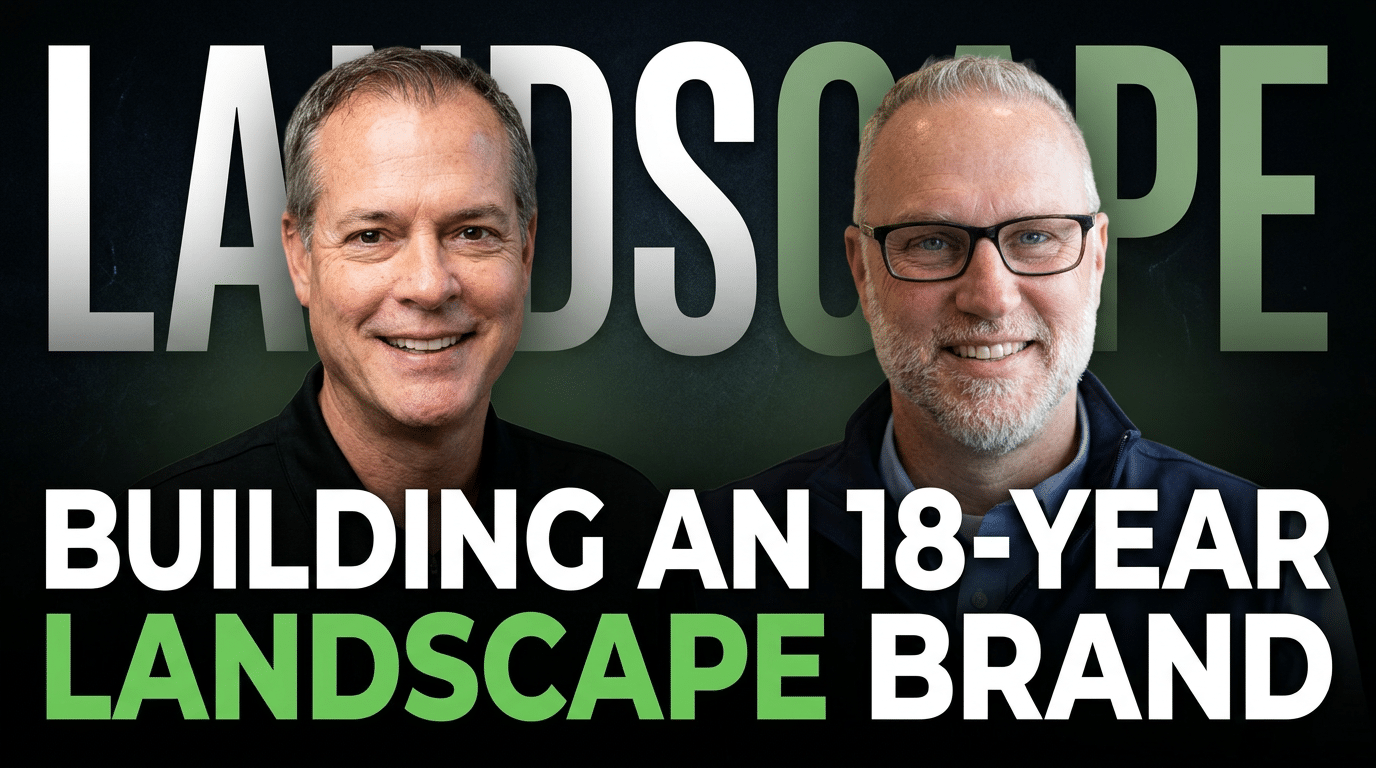
Eric Weishaar started Breckenridge Landscape in 2009. Not in a boom year, not with a clear runway, and not with the economy behind him. He launched a landscape construction company in southeast Wisconsin during the Great Recession, when most businesses were contracting rather than building anything at all. “What better idea,” he told Todd Baldwin on the Everyday Excellence podcast, “than to start a landscape company in Wisconsin in the Midwest in the middle of a recession?”
He said it with the kind of dry humor that only comes from having actually survived it. Eighteen years later, Breckenridge Landscape has been on the Inc 5000, has been named to a local Future 50 list, and is booked out with both high-end residential outdoor living projects and complex commercial work including roof decks on high-rise apartment buildings in Wisconsin. Eric joined Todd for a conversation about what the growth actually looked like, what makes their marketing approach different from the typical home services playbook, and why the customer experience matters more than the finished product.
THE REAL IMPACT: EXPERIENCE IS THE PRODUCT
Breckenridge Landscape does not do lawn maintenance. They do not plow snow. Their work is entirely construction-based: outdoor kitchens, fireplaces, patios, permeable paver systems, and commercial roof decks on urban high-rise buildings. The list of things they build is long. But Eric is clear that the product is not the patio.
“The people that are going to refer you to their friends are going to talk about the experience. A lot of our competitors have some of the same skill sets. They may even design things that look great. But what we really focus on is the experience.”
He illustrates the point with a clear contrast. Imagine a homeowner whose crew builds a beautiful patio with a fireplace and an outdoor kitchen. Their friends come over and admire it. If the experience was good, the conversation starts with the crew: “You can’t believe how great these guys were. They showed up on time. They cleaned up after themselves. They power washed the driveway. If I ever had a question, I called the designer and he answered right away.” The patio is the backdrop. The experience is what gets talked about.
Flip that scenario and the conversation becomes: “Yeah, but it took twice as long as we thought, and there were a lot of mistakes and hiccups.” Beautiful work, bad experience. The referral machine shuts down.
To make this operational rather than just philosophical, Eric built three guiding principles for every person on his team, in the field or in the office: craftsmanship, professionalism, and communication. “Any issue or challenge that pops up is always rooted in one of those three things.” If communication is strong, most problems can be managed before they become complaints. If craftsmanship is consistent, rework disappears. If professionalism is the standard, the customer feels taken care of from the first site visit to the final walkthrough.
WHAT THEY TRIED: MARKETING FOR CONSTRUCTION IS NOT LIKE MARKETING FOR MAINTENANCE
The first thing Eric makes clear about Breckenridge’s marketing approach is that it looks nothing like what most landscape companies do. And that distinction is intentional.
“We’re not a drive and quote kind of place,” he told Todd. A company that does mowing, snow plowing, or routine maintenance can use digital lead platforms, generate volume, and push out quotes at scale. Construction does not work that way. Customers are not browsing for a landscape contractor the way they browse for a pizza delivery. They are looking for ideas, for inspiration, for a company they can trust with a $50,000 or $200,000 project. That requires a different approach entirely.
Eric describes Breckenridge’s marketing philosophy as “rifle” rather than “shotgun.” The goal is not to reach the maximum number of people and filter from the other side. The goal is to reach the right people and qualify them early, before significant time is invested on either side.
Garden shows have been a cornerstone of that approach. Breckenridge creates displays that stop people in their tracks, not to generate excitement about a specific design, but to start a conversation. “The goal is get people to stop so we can have a conversation with them and then qualify them.” Half a dozen well-qualified leads from a single show has been a consistent return. Those leads do not all convert immediately. Some come back a year later. But the quality of the initial conversation is what makes them worth pursuing.
The “Bid on Milwaukee” program has been another channel that has worked well. Through a local radio station, Breckenridge offers up a landscape package that listeners bid on. The company receives roughly $50,000 to $70,000 in annual radio ad credit in exchange. Commercials run consistently without requiring the ongoing budget commitment that traditional radio advertising demands. It is the kind of creative arrangement that requires thinking outside the standard media buy.
Grassroots outreach has also produced real relationships. Eric’s team will walk into builder shows during slow afternoon hours when exhibitors are available and engaged rather than overwhelmed, start conversations, and build relationships with builders and other trades professionals. Several recurring commercial referral relationships have started this way. Todd called it what it is: the kind of marketing that is harder to measure but produces some of the most qualified leads a business can get.
WHAT’S WORKING NOW: DIGITAL, VISUALS, AND LEAD TRACKING
The Two-Step Digital Formula
Eric views digital marketing through a straightforward two-step lens. Step one is the hook: the ad, the social post, the search result that gets someone to click. Step two is the reward: the landing experience that turns that click into a conversation.
“You’ve got to have a good landing page. You’ve got to have a good website, especially if you’re in a visually-oriented industry like us.” His team has refined this over years of watching what works. At garden shows, they track which project photos generate the most attention from people walking by. Those same images become the visual anchors on the website. The assumption is simple: if a photo stopped someone at a trade show, it will stop someone on a landing page for the same reason.
Todd reinforced this from the Everyday Media Group perspective. Getting traffic to a site is one piece of the equation. What happens when that traffic arrives determines whether the campaign actually works. A visitor searching for outdoor kitchens should land on a page about outdoor kitchens, with compelling photography and a clear path to contact. Every mismatch between what the ad promised and what the landing page delivers is a lead lost.
Tracking Lost Leads as a Performance Signal
One of the sharpest operational insights Eric shared is that his team tracks not just where leads come from and what converts, but specifically why leads do not convert. That distinction, rare among small and mid-size businesses, is what turns a lead database into a learning system.
“If they’re getting the same problem arising over and over, like it took too long to get back to me, or your pricing is too high, well, then that’s something you can address.”
Patterns in lost leads reveal operational problems that no amount of additional ad spend can fix. A consistent complaint about response time is a process problem. A consistent complaint about pricing is a positioning or qualification problem. Identifying which is which allows the business to fix the right thing.
Todd noted from Everyday Media Group’s work with outdoor living and construction clients: the businesses that share this kind of closed-loop data, not just lead volume but lead quality and conversion data, are the ones that can actually make informed marketing decisions. Without it, optimization is guesswork. With it, every campaign improvement is grounded in real outcomes.
Everyone Is in Marketing
One of the most practical points in Eric’s conversation with Todd is also one of the most commonly overlooked in home services. Every person who wears the company uniform, drives the branded truck, and plants the yard sign is a marketing asset. “Everyone on your team is in marketing.”
Eric shared a specific example: a neighbor watched Breckenridge’s crew work on a project across the street for three weeks, then walked over to ask about their own project. The reason? The neighbor had started another job three weeks before Breckenridge, and Breckenridge was already done. That kind of visible, efficient, professional presence on a jobsite is a lead generation tool that no ad platform can replicate, and it costs nothing beyond doing the work well.
THE LESSON
Breckenridge Landscape’s marketing approach illustrates a pattern that Everyday Media Group sees with the strongest home service and outdoor living companies: the best marketing is an amplifier, not a substitute. When the underlying experience, the communication, the craftsmanship, and the professionalism, is consistently strong, marketing amplifies that into referrals, word of mouth, and digital visibility that compounds over time.
For outdoor living and landscape construction companies, the visual presentation of finished work is one of the most powerful conversion tools available. A strong photo of a completed project, used consistently across the website, social media, and paid advertising, does what no amount of keyword targeting can do on its own: it shows the customer what is possible and creates a reason to reach out. EMG works with outdoor living contractors to build digital marketing programs anchored in the company’s own work, driving traffic through Google and converting it through landing pages designed specifically around the projects they want to replicate.
Visit everydaymediagroup.com to learn more about how we help outdoor living and construction businesses build digital lead pipelines that match the quality of their work.
KEY TAKEAWAYS
1. Construction marketing requires a rifle, not a shotgun.
Volume-based digital lead generation works for maintenance and repeat service businesses. Construction works on relationships, qualification, and trust. The marketing approach has to match the sales process, which in high-end outdoor living starts with a conversation, not a quote.
“We’re more of a rifle shooting marketing approach. We’re trying to cultivate relationships and referrals and have conversations with people.”
2. The landing experience determines whether digital marketing pays off.
An ad that drives traffic to a generic homepage is not a marketing investment. It is a marketing expense. The landing page has to earn the click. For visual industries like landscape construction, that means high-quality project photography that reflects exactly what the customer is looking for.
“What we need to reward them with in our industry is something that’s visually appealing. Something they look at and go, wow, this is really neat. I’d love to see that in my yard.”
3. Tracking why leads don’t convert matters as much as tracking where they come from.
If response time is a consistent reason for losing leads, no additional marketing spend will solve it. Identifying patterns in lost opportunities surfaces the operational fixes that make the marketing actually work.
“We really try to find out why some of them didn’t convert. That is equally important. If you can find out if there are patterns, then that’s something you can address.”
ABOUT THE GUEST
Eric Weishaar is the owner of Breckenridge Landscape, a landscape construction company based in southeast Wisconsin serving the Milwaukee and Madison markets. Founded in 2009, Breckenridge specializes in high-end residential outdoor living projects including patios, outdoor kitchens, fireplaces, and custom landscape design, as well as commercial landscape construction including permeable paver systems and roof decks for high-rise developments. The company has been recognized on the Inc 5000 and on a local Future 50 list. Eric is also developing a youth sports complex in Wisconsin that will be the largest in the state.
Running a landscape construction or outdoor living company and looking to build a digital marketing program that matches the quality of your work? Everyday Media Group works with outdoor living contractors to drive qualified leads through Google and convert them with landing pages built around your best projects. Visit everydaymediagroup.com to schedule a free consultation.